More Than Just Spreadsheets: How AI Predicts and Resolves Supply Chain Disruptions in Indonesia
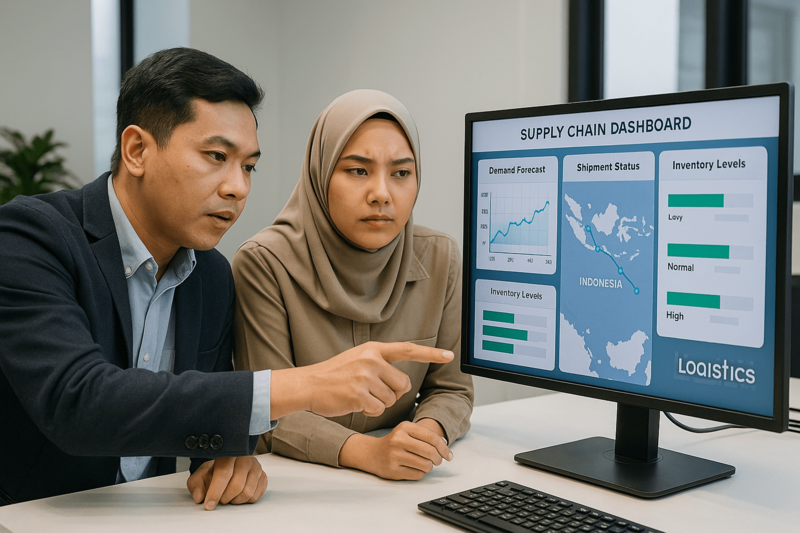
In the ever-evolving world of supply chains—especially in dynamic markets like Indonesia—speed and accuracy in decision-making are crucial. Unfortunately, many companies still rely on spreadsheets like Excel to manage their supply chains, which are very limited in handling today’s complexities. Artificial Intelligence (AI) has emerged as a more adaptive and predictive solution. This article systematically explains how AI works to predict and resolve supply chain disruptions in Indonesia, complete with real-world examples and measurable results.
The Limitations of Excel in Managing the Modern Supply Chain
Excel is indeed flexible and easy to use, but it is not designed for the dynamics of the modern supply chain. Some of its major limitations include:
1.No connection to real-time data from the field
2.Inability to analyze complex disruption patterns
3.Requires manual input, prone to human error
4.Difficult to integrate with other operational systems (ERP, IoT, logistics systems)
With supply chains involving multiple variables—from global suppliers to deliveries in remote regions—companies need systems that can anticipate, not just record, events.
The Importance of Prediction in an Uncertain Logistics World
Supply chains are highly vulnerable to external disruptions such as extreme weather, regulatory changes, and imbalances in supply and demand. In such conditions, the ability to predict possible scenarios becomes key to efficiency and business continuity.
AI enables companies to anticipate fluctuations and risks through predictive modeling. For instance, by analyzing historical data and seasonal trends, the system can forecast demand surges or potential delays from certain vendors.

How AI Detects Patterns of Supply Chain Disruptions
To accurately detect potential supply chain disruptions, AI works through three systematically connected stages: data collection, predictive analysis, and automated action recommendations. Here’s how an AI system truly helps businesses identify risks before they become real problems.
1. Data Collection and Integration
The first step is for AI to access and combine various types of crucial supply chain data, such as:
1.Delivery history and delays from various vendors
2.Real-time inventory status and stock movement
3.Data from IoT sensors in trucks and warehouses (e.g., temperature or GPS position)
4.Weather forecasts, economic news, and national holiday calendars
All this data is consolidated into a continuously updated platform. With this foundation, AI has a complete and up-to-date “situation map” to analyze.
2. Predictive Analysis and Anomaly Detection
Once the data is collected, the AI system runs machine learning algorithms to learn from past patterns. For example, it can recognize:
1.Recurring delays from a specific vendor
2.Trends of overstocking or stockouts in certain warehouses
3.Seasonal demand fluctuations before major events like Ramadan or year-end holidays
AI also uses anomaly detection to catch early signals of minor disruptions—often missed during manual checks. For instance, if a vendor’s average delivery time increases by 15%, the system will immediately issue an alert.
Additionally, time-series forecasting enables AI to predict demand spikes well in advance, based on past trends and patterns.
3. Action Recommendations and Automated Responses
After detecting potential disruptions, AI doesn’t stop there. The system immediately provides recommendations or executes automatic actions, such as:
1.Sending alerts to the operations team when product storage temperature becomes unstable
2.Reorganizing delivery routes based on weather and traffic data
3.Triggering reorders from alternative suppliers when stock levels drop, especially before high seasons or major promotions
All of this happens in real-time and automatically—with speed and accuracy that’s difficult to achieve using manual reports.
With such a system, disruptions like delays, stock shortages, or unexpected demand can be identified and responded to much earlier. AI helps companies move quickly before problems actually occur.
Examples of Disruptions AI Can Predict Early
AI can recognize various disruption scenarios with high accuracy. Some examples include:
1.Vendor performance decline: Based on worsening lead time over the past 3 months, AI detects that Vendor A is at high risk of causing delays and suggests contract evaluation.
2.Stock shortages before national holidays: The system identifies rising demand trends before Eid based on data from the past 3 years, then recommends stock replenishment 4 weeks in advance.
3.Potential distribution disruption due to extreme weather: AI combines weather forecast and logistics route data, then suggests rerouting distribution before flooding affects the main delivery path.
These examples show that AI can serve as a highly accurate early warning system for logistics managers.
Automatic Action Recommendations: Ready Before It's Too Late
AI not only detects potential issues but also provides actionable recommendations that can be executed immediately. Examples include:
1.The system suggests ordering extra stock from an alternative supplier when the main stock is predicted to run out.
2.Rescheduling deliveries to faster logistics routes based on traffic and weather predictions.
3.Switching to distribution warehouses located closer to high-demand areas.
With these automation features, companies can act proactively before problems impact the customer.

Comparison: Companies Using AI vs. Manual Systems
Companies that still rely on manual systems typically face challenges such as slow responses to disruptions, mismatches between stock and demand, and dependency on vendors without backup plans. These issues are often only detected after they’ve already significantly affected operations.
In contrast, companies that have integrated AI technology into their supply chains can read situations earlier and act faster. With predictive systems that continuously learn from data, companies no longer merely react—they anticipate. This is the fundamental difference between companies that only view data as reports and those that leverage it as a strategic tool.
Conclusion
In a logistics world full of uncertainty, supply chain resilience is no longer optional—it’s a necessity. Manual spreadsheets can no longer keep up with the speed and complexity of modern operations. AI offers a competitive advantage through intelligent predictions, early disruption detection, and automated action recommendations. By adopting AI-based systems, companies in Indonesia can strengthen their supply chains and maintain customer satisfaction amidst ever-changing challenges.
Use AI from Smart IT to Build a More Resilient Supply Chain
Smart IT Indonesia provides customizable AI-based supply chain system development tailored to your business needs. By integrating machine learning, IoT, and predictive dashboards, we help you minimize risk, reduce logistics costs, and accelerate decision-making. Don’t wait until your system collapses due to preventable disruptions—contact the Smart IT team now for full AI integration in your supply chain operations.
PT SMARTIT MANTAP DIGITAL INDONESIA
Vieloft Ciputra World, Suite 10-01.
Kompleks Superblock, Ciputra World
Jl. Mayjen Sungkono No.89 Surabaya, Jawa Timur, Indonesia 60224
Telepon: +6281130576888 / +628113426391
Email: hello@smart-it.co.id
Facebook: Smart IT Indonesia
Linkedin: Smart IT Indonesia
Instagram: smartitcoid